Showing posts with label goth. Show all posts

Thursday, January 12, 2017

Goths in Media

Last official post!

Here's a list of my favorite goth characters in media (in no particular order)!

Nancy Downs, The Craft - 1996


The Craft, for those of you who have never heard of it, is basically mean girls, but with witchcraft and murder. Nancy is pretty much Goth Regina George- trying to seduce the main character's boyfriend, and then trying to murder her. Or, trying to get her to commit suicide. Nancy is an incredibly interesting character- shown as a troubled girl with an abusive stepfather just trying to cope, but magic slowly drives her to insanity as she craves more power.

Wednesday and Morticia Addams, The Addams Family

Image result for wednesday and morticia addams

Two in one! Morticia is the seductive and dark mysterious woman who has her husband wrapped around her finger, whereas Wednesday is dark, emotionless, and cynical. They're everything every goth tries to be. Both humorous and quick witted, they're thoroughly well written characters. 

Lydia Deetz, Beetlejuice - 1988

Related image

Played by Winona Ryder, Lydia is the girl who many Goths look up to. An aspiring photographer, who is, herself, strange and unusual, and almost was married to a ghost. What could be better than that? Well, I wouldn't want to marry Betelgeuse. Neither did she, I guess, though.

Elvira, Elvira's Movie Macabre 1981-1986 (As well as other productions)

Related image

Elvira is one of my guilty pleasures. Or, I've been told I should feel guilty about loving her character. Oh well. The busty horror hostess's quick wit, sass, and mix of valley girl and Gothic 'tude are just oh so good. (Also the recurring joke in Elvira, Mistress of the Dark that she was born in her goth makeup- hilarious!) Maybe other goths want to be mysterious and reclusive, and cut roses off of their stems- but I want to be Elvira!

Creep it real, folks!


Vocabulary: Cybergoth

Cybergoths, also known as 'Gravers' (or Gothic ravers), have a very unique style, mixing raver styles, steampunk, industrial, and gothic fashion.

Image result for cybergoth

Cybergoths can be spotted sporting neon dreadlocks, gas masks, goggles, big boots, fishnets, vinyl, and fur. Cybergoths usually wear black and monochromatic neon colors, matching their hair, makeup and clothes.

Their "cyberlox" or dreadlocks can be natural or, made of yarn, plastic, cables, and more. Many put LED lights in their locks.

Image result for cybergothThe term "Cybergoth" was coined in the 80's for the RPG game "Dark Future" and has been evolving ever since.

Cybergoths don't often listen to gothic rock- they merely take the title of Goth based on aesthetics. Often cybergoths listen to industrial, techno, electronic, or dance music.


Creep it real!

Buying Alternative Clothes Online?!

Not everyone lives somewhere they can buy alternative clothes in their area, so here are some websites that sell alternative clothing (albeit they're a little expensive)!

Goth/punk/dark:
https://www.killstar.com/
https://www.rebelcircus.com/
https://www.disturbia.co.uk/
https://iamattitude.com/
http://www.darksideclothing.com/
https://store.kreepsville666.com/
http://www.dollskill.com/
http://www.rebelsmarket.com/

Lolita/kawaii/cute:
http://www.lolitadressesshop.com/
https://syndromestore.com/
http://www.dollskill.com/dolls/kawaii-clothing.html
https://www.spreepicky.com/
http://www.cutejapanesefashion.com/

Enjoy!

Wednesday, January 11, 2017

Black Phillip Goth Makeup Tutorial

The video below is a video by youtuber Drac Makens. I thought it was very interesting. I love the look!

 
Creep it real!


Person of Interest: Emilie Autumn

Autumn performing during a Fight Like A Girl Concert
Emilie Autumn was born in Los Angeles, California. She is a singer, world-class violinist, harpsichordist, novelist, poet, actress, and more.


Autumn during the Enchant era


Autumn's historical knowledge, singing abilities, and skills as a writer (of both prose and poetry) were all self taught. She is still a published poet and her novel, The Asylum For Wayward Victorian Girls, is cited in textbooks in Oxford University's psychology curriculum despite being removed from school at age ten, to perfect her skills as a child prodigy violinist.

Autumn originally  planned to become merely a classical composer and violinist, but then realized that her voice was necessary for her to truly express her art and views.
 

Autumn during her Opheliac album cover shoot.
All of her costumes are hand sewn by Autumn herself.
Autumn, being a sufferer of bipolar disorder, a vegan, and a feminist, is very outspoken about gender equality, mental health care reform, and animal rights in her music and writing. Autumn encourages women to "fight like a girl" and to be strong in times of trouble.


EA is now well versed in industrial rock as well as classical music- shown especially by her 2007 album Laced/Unlaced- a two disc instrumental album. Disc one- Laced- is all classical, whereas disc two - Unlaced- is all metal and industrial rock recordings on electric violin.

Below is her song "Manic Depression", which shows her skill as both a classical and rock artist with the violin.


Autumn's half-autobiographical, half-fiction novel The Asylum For Wayward Victorian Girls, based on Emilie's own diary while she was in a mental hospital after a suicide attempt, is currently in the production stage of becoming a Broadway musical.

Her fans - plague rats, as they're called - flock to her concerts with her signature heart painted on their cheeks to hear and see her elaborate and dramatic performances that could almost be called musical theater.


Thursday, January 5, 2017

Person of Interest: Anna-Varney Cantodea


Anna-Varney Cantodea is a musician, and the only member of the band Sopor Aeternus & the Ensemble of Shadows, a Gothic Rockish, Dark Waveish, Neoclassicalish band.


Anna-Varney Cantodea's work is highly personalized, poetic, and melancholic. She refuses to perform "in front of humans". The reason for this is largely unknown but it is speculated that it is either childhood trauma and to perpetuate her image of being a reclusive an"odd creature".

Cantodea herself dresses as a sort of Nosferatu-esque vampiric Victorian noblewoman.

When she was a child, she claims in an interview to have had a vision of her future self in a train station as “an ageless creature (of undefinable gender), all dressed in black, with a beautiful, kind of pennate black Mohawk". When she started her band, Sopor Aeternus, in 1989, she modeled her appearance after this vision.

Cantodea's gender identity is also up to speculation, she was designated male at birth, but some sources say that she identifies as a two-spirit, but others say that she is a transgender woman, but all consistently use she/her pronouns.


Her original stage name, Varney, was chosen and based off of the vampire in the 19th century novel, Varney the Vampire by James Malcolm Rymer and Thomas Peckett Prest. Later, she added on the feminine "Anna" to the front, and the last name of "Cantodea", which means "I sing, Goddess" in latin.

Cantodea is a strong advocate for animal rights, veganism, and LGBT+ rights.

If you wish to donate to support her upcoming album, click here!

Wednesday, January 4, 2017

Are Goths Racist?

Goth people are known for their pale and vampiric sickly pallor, contrasting with dark hair, clothing, and makeup.

Is this image harmful to people of color? And does it deter POC from wanting to be part of the subculture? Are goths, as a group, racist?


Popular Goth youtuber It's Black Friday
First off, there's nothing wrong with being pale, or painting your face white and doing all of the "typical Goth things".

But, let's recount the number of people in popular goth media who are people of color:
Elvira? No.
Robert Smith? White.
Siouxsie Sioux? She's from England AND she uses Sioux culture as a fun moniker. I love her, but yikes.
Andrew Eldritch? A jerk AND a white dude.
Oh! Oh! I've got it- Gomez Addams is Spanish-American! ..And a stereotype of the "Latin Lover". That's half a point, right..? Wait, is Gomez Spanish or Italian? I'm just confused now.
Tim Burton? He thought that the Brady Bunch adding in an Asian and Black character was offensive somehow, and that there "should be more white people in these movies." And when have you ever seen a person of color in a Burton film? (Answer: The villain in Miss Peregrine's Home For Peculiar Children... Nice job perpetuating the idea that black people are somehow evil or morally inferior to white people.) We were rooting for you, Tim.
Poe was alive in the early 1800's, so that's pretty self explanatory, yeah?
HP Lovecraft is pretty well known for his racism, too.

And there's never been a person of color on the cover of Gothic Beauty magazine.

Well. Goth media is pretty white, but what about the group of people themselves?

So, there are plenty Goths of color. Well, a decent amount. The (somewhat) famous youtube Goth makeup artist, Drac Makens, is in fact latina. She is very proud of her heritage and talks about it frequently on her youtube channel and her instagram.


Drac Makens in her Emilie Autumn inspired makeup look
People love Drac, regardless of her race. It seems not to be a problem when it comes to her, so why are there no popular Black, South Asian, or other Goth youtubers with darker complexions? Is it because they don't exist, because their content isn't good enough, or the obsession with pale skin on goths?

Do they "not exist" (they do.) because they don't feel safe in the subculture?

Serene Pristine, a black Goth woman, talks about her experiences in this article. At age 16 she went to a Bauhaus concert, and was waiting at the very front of the line. A group of white goths saw her, and Serene says that they  "took one look at [her] and I sensed they thought [she] was inferior". They tried to cut in front of her in line, but a security guard defended her. Serene says that she doesn't feel as safe going out in real life as a Goth of color, when she did, her peers would call her an "oreo" or ask her why she listened to "white music". Online, she would get anonymous racist hate messages attacking her for having the "audacity" to be black and like Gothic Rock. 

Serene Pristine
Serene Pristine, a Black poet and Goth

Goths claim to be progressive and accepting, but still there is huge elitism within the subculture. Goths are different, sure, but to be different, you are expected to be different in a way that conforms to other Goths' expectations. Isn't that backwards? 
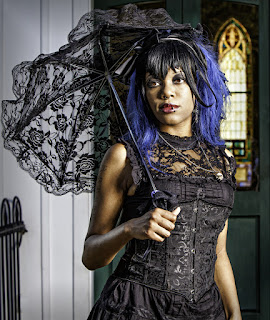
I can't say that individual Goths are racist, because I don't know every individual Goth. In fact, I'd hazard a guess that most Goths aren't racist (Consciously, at least. Most people do have a societally ingrained internalized racism deep in there. Or not so deep). But there is an air in the culture that still supports and protects racism within the community. Alternative subcultures are supposed to be safe spaces for anyone who is different, and go against societal norms and expectations. Looking down on someone for their skin color and not "allowing" them into an alternative community is actively going against what alternative subcultures are supposed to stand for. Alternative communities should be safe places for strange people, no matter what their race. Our strangeness is what bonds us together, not our whiteness.

Creep it real.


*If I said anything offensive, incorrect, or overstepped my bounds on here, please let me know and I will try my best to revise this article to be as racially sensitive as possible. Thanks!

On the other hand, if you have an issue with my comment about Andrew Eldritch, contact me, and I will laugh at you. Not sorry.

Monday, November 7, 2016

Alternative Fashion & Mental Health

Collaboration with Abbi!

With the slew of articles linking depression, self harm, and Goth fashion, one has to ask- why?

A study of 2,300 british teens conducted by Oxford University found that 15 year olds “who identified as a Goth were 27% more likely to have depression at 18 years” than their peers. This blew up the media- but the results were inconclusive. The research could not prove that goth is at fault for the mental health issues of teens, but many articles and concerned parents seemed to ignore the fact that the link between might be muddled- it could be peer contagion, or a preexisting disorder. "I was depressed and ill before I was a goth" Nattalie Richardson, 29, said in response to the idea that goth leads to depression and self harm.


The researchers did not specify that depression was causing kids to join the goth subculture, or if the goth subculture was causing their depression. The teens could be attracted to the goth community for a sense of solidarity and comfort, as “the Goth community is traditionally very accepting of marginalized individuals”. It could be that “youths who feel isolated from mainstream society are attracted to this particular group, and may indeed gain support and help through being part of this subculture,” Lucy Bowes, researcher for Oxford University said. "Teenagers who are susceptible to depression or with a tendency to self-harm may be attracted to the goth subculture which is known to embrace marginalized individuals," said Rebecca Pearson from the University of Bristol in Britain. Those who identified as goth had a family history of depression, have been bullied, or have behavioral and emotional problems already. There is no way to prove that if the individual would not have developed depression by 18 years old if they had not been a part of the goth community, but nonetheless, goth teens were three times more likely to be depressed than other, “normal” teens.


Still, researchers say that parents should not try to stop their children from being part of a goth group or being goth, because belonging to a group and having friends provides solidarity and comfort to depressed teens.

“Parents whose children identify with the Goth subculture need not be concerned,” Bowes said. “The majority of teenagers identifying as a Goth in our study were not depressed and did not self-harm.”

Is correlation causation? Should parents of young goths be concerned?


Tuesday, November 1, 2016

How To Get Alternative Clothes Without Breaking the Bank

So, I'm seventeen years old and I don't have a license, a car or a job. (I know, I'm a deadbeat) Sometimes I feed my neighbors' cats while they're away? That's kind of a job, right? (It's not.) But anyway, I don't have a stable source of income, so I can't really afford extravagant clothes and $50 shoes from dollskill or killstar or etsy or whichever alternative fashion websites are around these days.

So how do I dress the way I want to with the little money I have?

1980's/1990's clothing
Image from the Garment District's website


First of all: Thrift stores. Lots and lots of thrift stores.
I go to thrift stores and I pick up anything I like and everything black, meshy, lacy, etc.
Most of my favorite clothes are from thrift shops, they're where you can find really unique and vintage clothing that isn't for sale anymore anywhere else.
If anyone lives in the Boston area, my favorite thrift shop is called The Garment District in Cambridge, and they have a huge pile of clothes that you can pick whatever you like out of, and clothes are $2 per pound, or $1 per pound on Fridays! They're also connected to Boston Costume, which also has costume clothing (read: goth year round clothing) such as fishnet sleeves, bone tights, and more. They also sell manic panic, if that floats anyone's hair dye boat.

Secondly: Online!
Ebay, Amazon, and SheIn honestly have some cool and cheap clothes, especially things meant for costumes that are available year round. Look online for wholesalers, too!

Third: Costume and Halloween stores!
Now is the perfect time of year for someone like me to get new outfit pieces.
One of my favorite necklaces (blood necklace, anyone?) is party city couture. The only problem with this is that it's seasonally based, and the clothes have that... Cheap plasticy smell. And aren't very good quality. And the jewelry will turn you green. And the earrings will probably give you an infection, so avoid that. But if your fishnets get holes in them, you'll just look edgier, so give it a shot!

Lastly: Do it yourself!
Never underestimate the power of the DIY. You can dye white clothes black or purple, cut the sleeves off things, spraypaint designs onto your clothes, the world is your oyster!
I'm currently working on a project where I'm cutting the back out of one of my t-shirts and replacing the back with lace from an old skirt my art teacher gave me. This is one of my favorite methods, it's loads of fun and you end up with a unique garment in the end! It's awesome!

There are also tons of videos on goth and punk DIY-ing on youtube including these two by one of my favorite youtubers. (Warning: videos may contain curse words, and are pretty long!)

Creep it real!
Si


Monday, September 26, 2016

Gender and Alternative Dress

Gender is a really hot topic (no pun intended- I swear!) going on in the world right now. With transgender presence being portrayed more and more in television, Hillary Clinton being the first female presidential candidate for the upcoming US election, and transgender bathroom rights being fought for in the supreme court, people all over the world are talking about gender. How does gender relate to alternative dress?

Being nonbinary and being part of the goth subculture, I have a decent amount of experience with gender expression and gender identity in the subculture, but we're going to discuss punk and lolita fashion here as well (just because these were the three I felt were the most accessible for research)! Feel free to correct me if I have something incorrect or left something out, I'm not an expert, just passionate!

PUNK

A punk woman posing


In the punk scene, the whole idea is to reject mainstream and socially accepted ideas, so the concept of gender and gender expression are often toyed with to make others question their views on gender and its expression. In the height of the scene, people would often crossdress or present androgynously, and gender was seen as insignificant in regards to expression. Relevant in the 70's, and perhaps even more so today.

Women in the punk subculture are seen as equal to men, and women historically have this as a way to parody masculinity and toy with societal expectations of what "man" and "woman" truly mean. Women in the punk subculture can be openly and unadulteratedly  feminine, in a way that isn't "soft" or fetishized.

One issue with this expression of femininity was that women were expected to be "shocking" and this often involved women's nudity and sexuality being used to do so. Some believe that this was not progressive or a form of equality, but that this was just another method to objectify women's bodies.

GOTH

Goth & nonbinary Instagram and Youtube user VforVoid

Connected with punk (somewhat), In the goth community, makeup is essentially expected to be worn by people of all genders. Men wear makeup and skirts, as do the women, and the nonbinary people.  The gender boundaries are also blurred as they were in punk, as people in the goth subculture are encouraged to experiment and play with their clothing, hair, and makeup. In my own personal experience, the community as a whole is very accepting of transgender and nonbinary people. I have never viewed any sexism in the goth subculture, and I think this is due to goth originally branching off from the post-punk scene, where men and women were seen as equal.

One "issue" with goth is that femininity is more coveted than masculinity- everyone is expected to be feminine, but it's rarely heard of when a goth woman dresses in a masculine fashion. Men are to be feminine, nonbinary people are to be feminine, and women are often expected to be, perhaps, hyperfeminine.

(I, personally take little issue with this, I feel as though femininity is something that everyone should embrace, despite their gender, but I can see the issues with the expectations and harm in women having to subscribe to traditional gender roles when others are free to play with their expression more. But, I feel as though many women don't feel a pressure to be "feminine" in the goth subculture; it is due to a personal expression and a want to dress in more elaborate dress, rather than being pressured.)

LOLITA

a woman in "princess lolita" fashion

In Lolita fashion the gender roles are more rigid- but the floofy skirts and lace aren't only for girls in Lolita. Men in Lolita oftentimes are crossdressing  and as far as I know, men crossdressing and wearing makeup is accepted in the community.

I haven't seen many male Lolitas online, or at any sort of conventions, which makes me feel as though it's less accessible to men. (But perhaps it's just because I don't personally look at Lolita fashion online very often.)

I feel as though Lolita raises the same problem as goth did involving femininity, but perhaps to an even greater extent. Lolitas are expected to be and act cute and doll-like, common and ideal "feminine" traits, so there is an even greater pressure to conform to gender roles and be hyperfeminine, but again, I feel as though this is an issue of personal taste rather than an issue of being pressured to do something. But, I do feel as though Lolita's expectations for behavior may be harmful to women. (thoughts?)

Due to Lolita's enforcement of traditional gender roles being more so than other subcultures I've looked at, I was concerned that transgender people may be less accepted in the community, so I dug around and did some research. I was pleasantly surprised! I found this article about an older transgender Lolita, and she said that many people in her Lolita group are very accepting! Great!

CONCLUSION

All in all, I feel as though alternative people are more accepting of playing with gender expression and gender roles than "normal" people. Of course, each subculture involves issues, but they are leagues ahead of where mainstream society is with gender expression, equality, and identity.

Thanks for reading, and as always, creep it real!


Si

Friday, September 16, 2016

Vocabulary: What Is "Goth"?

In short, "Goth" is a style of dress closely intertwined with the musical genre of gothic rock.
Goths are people who dress in all- or mostly- black clothing with lace, fishnets, and dark or unusual makeup.

Goth History lesson:

"Goth" is a word that came from a Germanic tribe known under the same name (the Goths). Later on, "gothic" was a word used to apply to medieval style architecture, and then to literature in the late 18th century to early 19th century that usually involved death, mysticism, and the supernatural.

Goth, as a subculture, began in the late 1970's to early 1980's as a branch off from the post-punk genre.

Due to the style of goth being so closely tied to the musical genre of gothic rock, often singers for bands were the fashion icons of goth culture.
A handful of these early fashion influencers include Siouxsie Sioux of Siouxsie and the Banshees, Robert Smith of The Cure, & Patricia Morrison of The Sisters of Mercy.


Siouxsie Sioux
Patricia Morrison

Robert Smith


Special mention awards for goth fashion icons include Peter Murphy of the band Bauhaus, Bela Lugosi as Dracula in the 1931 film, the characters Morticia Addams (The Addams Family), Elvira (Elvira, Mistress of the Dark), and Lydia Deetz (Beetlejuice).

 Goth has branched off quite a bit since the 70's. There are now "substyles" of goth that that include "romantic goth" (more Victorian inspired) and "batcave goth" (closer to what earlier, punkier, goth dress was).
(more 70's and 80's inspired)
The video Below by Liisa Ladouceur, author of Encyclopedia Gothica, provides a good, brief overview of how the style of goth has evolved and branched off since the 1970's.