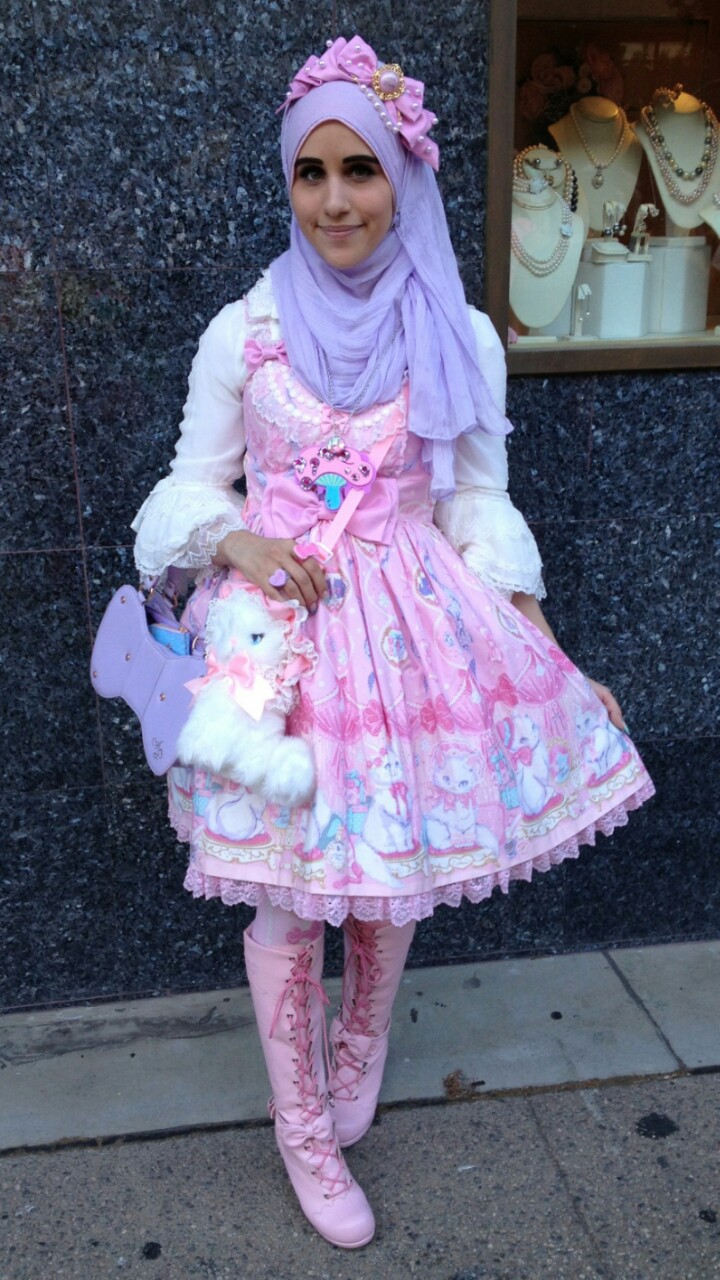
Not everyone lives somewhere they can buy alternative clothes in their area, so here are some websites that sell alternative clothing (albeit they're a little expensive)!
Goth/punk/dark:
https://www.killstar.com/
https://www.rebelcircus.com/
https://www.disturbia.co.uk/
https://iamattitude.com/
http://www.darksideclothing.com/
https://store.kreepsville666.com/
http://www.dollskill.com/
http://www.rebelsmarket.com/
Lolita/kawaii/cute:
http://www.lolitadressesshop.com/
https://syndromestore.com/
http://www.dollskill.com/dolls/kawaii-clothing.html
https://www.spreepicky.com/
http://www.cutejapanesefashion.com/
Enjoy!
Goth, Punk, Lolita, & more- Clothes are a way to represent and express oneself, so why is dressing 'out of the norm' seen as... well, out of the norm?
Showing posts with label Lolita. Show all posts
Thursday, January 12, 2017
Wednesday, November 16, 2016
Does Lolita Fashion Promote Pedophilia?
TW for pedophilia, sexualization of children, and child sexual assault mentions in the following post. Read at your own risk.
Lolita is a controversial novel by Russian author Vladimir Nabokov. Lolita was published in 1955 and is about a middle-aged professor named Humbert Humbert becoming obsessed with and sexually fantasizing about his landlord's 12-year old daughter, Dolores (whom he nicknames Lolita). He becomes "sexually involved" with Lolita after he marries her mother. After Lolita's mother dies by being hit by a car during an argument with Humbert, Humbert takes Lolita from her boarding school and has to bribe her and manipulate her to stop her from going to the police. During this time, Humbert also bribes Lolita with candy and fun events for sexual favors. Eventually, Lolita runs away from Humbert and gets married to another man who knows nothing about her past. He spends years looking for her, but when he finds her, she is 17, pregnant, and in need of money. Humbert gives her the money, and leaves her alone.
So what does Lolita fashion have to do with the novel? And does it promote pedophilia? Based on the name of the fashion style sharing a name with the novel, one could make snap judgments and say "of course!", but I'm here to discuss both sides of the argument.
Firstly, the name has not been confirmed to have a connection with Nabokov's novel- but where else could the name have come from? The women who wear Lolita fashion, particularly Sweet Lolita, are often expected to act sweet, childlike, and girlish. The makeup of many Lolita people is used to accentuate or imitate a young child's features- lots of blush, circle lenses to make the eyes look bigger, et cetera. The clothing is modeled after Victorian clothing, and the patterns are often modeled after children's and nursery wallpaper, featuring cute designs such as unicorns, food, children's toys, and more.
But is it necessarily wrong for women to wear a pink fluffy skirt with teddy bears on it? Just because we affiliate this style with children, does it mean that the people who wear this style are sexualizing it, and in turn, children?
There is an active portion of the Lolita community that does sexualize this, and there are plenty of people who find something about Lolita inherently sexual, and find the childlike act and clothing attractive. The things we see and are surrounded by are what helps us form opinions. If we're taught that grown women doing things commonly linked with children is sexy- we'll accept it. Which can be disturbing, because after we see that, we've made that connection- things that are associated with children = sexy.This does perpetuate the idea that something about children is attractive- and that's incredibly problematic. Plenty of people are able to discern that there is a difference between grown women and children doing something; but a large enough group isn't able to discern this. This is where the issues lie.
But, those people aren't the majority. Sometimes people just want to wear pink fluffy skirts and pastels and look cute. For a lot of people, Lolita has nothing to do with children. People just want to feel like princesses, or dress up with frills and feel decadent. There is nothing wrong with looking or wanting to look cute. The issue lies in associating Lolita fashion with children and sex simultaneously.
If members of the Lolita community can work to divorce the idea of their fashion with children, I believe there would no longer be an issue. I encourage members of the Lolita subculture to think hard about their clothing choices and activities, and think deeply about the consequences of affiliating with things linked with children when they are an adult with the ability to consent.
Creep it real!
Si
Vocabulary: Lolita Fashion
![]() |
| A group of Sweet Lolitas |
![]() |
| Classic Lolita |
Brief History of Lolita
Lolita is a fashion subculture that originated in Japan, specifically Harajuku with brands such as Angelic Pretty and Milk. Lolita fashion takes its inspiration from Victorian and Rococo eras and aims to be fanciful, fluffy, and elegant.The name of Lolita does not have any known roots but it shares its name with the novel by the same name by Vladimir Nabokov. There is no known connection between the two, though.
![]() |
| Gothic Lolita |
Lolita is thought to begin in the 1970's, popularized in the 1990's, partly as the more "feminine" counterpart of Visual Kei, along with Fairy Kei.
There are many subdivisions of Lolita, including Sweet Lolita, Gothic Lolita, Classic Lolita, and more.
Sweet Lolitas wear pastel clothing inspired by sweets and cute patterns. The goal of Sweet Lolita is to look as cute and, as the name implies, sweet! Sweet Lolitas' skirts are often shorter than those of Gothic Lolitas and Classic Lolis, their skirts stopping at or above the knee. This style is closest to fairy kei out of all subdivisions of Lolita.
Gothic Lolitas often wear styles similar to those that goths wear; usually black, spooky, lacy, Victorian-inspired outfits.
Classic Lolita is the most Victorian-inspired of the substyles of Lolita. It is often seen as the more "mature" version of the other styles of Lolita, due to the more toned-down colors and elegant fashion. (but I feel as though this is a bit of a bash on the other styles of Lolita!)
Many Lolitas buy their outfits- generally called "coords"; but due to the clothing often being expensive due to the elaborate stitching, pleating, and whatnot, but many also sew their own coords, and even sell them.
Creep it real!
Si
Monday, September 26, 2016
Gender and Alternative Dress
Gender is a really hot topic (no pun intended- I swear!) going on in the world right now. With transgender presence being portrayed more and more in television, Hillary Clinton being the first female presidential candidate for the upcoming US election, and transgender bathroom rights being fought for in the supreme court, people all over the world are talking about gender. How does gender relate to alternative dress?
Being nonbinary and being part of the goth subculture, I have a decent amount of experience with gender expression and gender identity in the subculture, but we're going to discuss punk and lolita fashion here as well (just because these were the three I felt were the most accessible for research)! Feel free to correct me if I have something incorrect or left something out, I'm not an expert, just passionate!
In the punk scene, the whole idea is to reject mainstream and socially accepted ideas, so the concept of gender and gender expression are often toyed with to make others question their views on gender and its expression. In the height of the scene, people would often crossdress or present androgynously, and gender was seen as insignificant in regards to expression. Relevant in the 70's, and perhaps even more so today.
Women in the punk subculture are seen as equal to men, and women historically have this as a way to parody masculinity and toy with societal expectations of what "man" and "woman" truly mean. Women in the punk subculture can be openly and unadulteratedly feminine, in a way that isn't "soft" or fetishized.
One issue with this expression of femininity was that women were expected to be "shocking" and this often involved women's nudity and sexuality being used to do so. Some believe that this was not progressive or a form of equality, but that this was just another method to objectify women's bodies.
Connected with punk (somewhat), In the goth community, makeup is essentially expected to be worn by people of all genders. Men wear makeup and skirts, as do the women, and the nonbinary people. The gender boundaries are also blurred as they were in punk, as people in the goth subculture are encouraged to experiment and play with their clothing, hair, and makeup. In my own personal experience, the community as a whole is very accepting of transgender and nonbinary people. I have never viewed any sexism in the goth subculture, and I think this is due to goth originally branching off from the post-punk scene, where men and women were seen as equal.
One "issue" with goth is that femininity is more coveted than masculinity- everyone is expected to be feminine, but it's rarely heard of when a goth woman dresses in a masculine fashion. Men are to be feminine, nonbinary people are to be feminine, and women are often expected to be, perhaps, hyperfeminine.
In Lolita fashion the gender roles are more rigid- but the floofy skirts and lace aren't only for girls in Lolita. Men in Lolita oftentimes are crossdressing and as far as I know, men crossdressing and wearing makeup is accepted in the community.
I haven't seen many male Lolitas online, or at any sort of conventions, which makes me feel as though it's less accessible to men. (But perhaps it's just because I don't personally look at Lolita fashion online very often.)
I feel as though Lolita raises the same problem as goth did involving femininity, but perhaps to an even greater extent. Lolitas are expected to be and act cute and doll-like, common and ideal "feminine" traits, so there is an even greater pressure to conform to gender roles and be hyperfeminine, but again, I feel as though this is an issue of personal taste rather than an issue of being pressured to do something. But, I do feel as though Lolita's expectations for behavior may be harmful to women. (thoughts?)
Due to Lolita's enforcement of traditional gender roles being more so than other subcultures I've looked at, I was concerned that transgender people may be less accepted in the community, so I dug around and did some research. I was pleasantly surprised! I found this article about an older transgender Lolita, and she said that many people in her Lolita group are very accepting! Great!
Being nonbinary and being part of the goth subculture, I have a decent amount of experience with gender expression and gender identity in the subculture, but we're going to discuss punk and lolita fashion here as well (just because these were the three I felt were the most accessible for research)! Feel free to correct me if I have something incorrect or left something out, I'm not an expert, just passionate!
PUNK
![]() |
| A punk woman posing |
In the punk scene, the whole idea is to reject mainstream and socially accepted ideas, so the concept of gender and gender expression are often toyed with to make others question their views on gender and its expression. In the height of the scene, people would often crossdress or present androgynously, and gender was seen as insignificant in regards to expression. Relevant in the 70's, and perhaps even more so today.
Women in the punk subculture are seen as equal to men, and women historically have this as a way to parody masculinity and toy with societal expectations of what "man" and "woman" truly mean. Women in the punk subculture can be openly and unadulteratedly feminine, in a way that isn't "soft" or fetishized.
One issue with this expression of femininity was that women were expected to be "shocking" and this often involved women's nudity and sexuality being used to do so. Some believe that this was not progressive or a form of equality, but that this was just another method to objectify women's bodies.
GOTH
![]() |
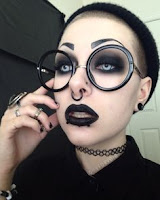
| Goth & nonbinary Instagram and Youtube user VforVoid |
One "issue" with goth is that femininity is more coveted than masculinity- everyone is expected to be feminine, but it's rarely heard of when a goth woman dresses in a masculine fashion. Men are to be feminine, nonbinary people are to be feminine, and women are often expected to be, perhaps, hyperfeminine.
(I, personally take little issue with this, I feel as though femininity is something that everyone should embrace, despite their gender, but I can see the issues with the expectations and harm in women having to subscribe to traditional gender roles when others are free to play with their expression more. But, I feel as though many women don't feel a pressure to be "feminine" in the goth subculture; it is due to a personal expression and a want to dress in more elaborate dress, rather than being pressured.)
LOLITA
![]() |
| a woman in "princess lolita" fashion |
In Lolita fashion the gender roles are more rigid- but the floofy skirts and lace aren't only for girls in Lolita. Men in Lolita oftentimes are crossdressing and as far as I know, men crossdressing and wearing makeup is accepted in the community.
I haven't seen many male Lolitas online, or at any sort of conventions, which makes me feel as though it's less accessible to men. (But perhaps it's just because I don't personally look at Lolita fashion online very often.)
I feel as though Lolita raises the same problem as goth did involving femininity, but perhaps to an even greater extent. Lolitas are expected to be and act cute and doll-like, common and ideal "feminine" traits, so there is an even greater pressure to conform to gender roles and be hyperfeminine, but again, I feel as though this is an issue of personal taste rather than an issue of being pressured to do something. But, I do feel as though Lolita's expectations for behavior may be harmful to women. (thoughts?)
Due to Lolita's enforcement of traditional gender roles being more so than other subcultures I've looked at, I was concerned that transgender people may be less accepted in the community, so I dug around and did some research. I was pleasantly surprised! I found this article about an older transgender Lolita, and she said that many people in her Lolita group are very accepting! Great!
CONCLUSION
All in all, I feel as though alternative people are more accepting of playing with gender expression and gender roles than "normal" people. Of course, each subculture involves issues, but they are leagues ahead of where mainstream society is with gender expression, equality, and identity.
Thanks for reading, and as always, creep it real!
Si
Subscribe to:
Posts (Atom)